About the Symposium
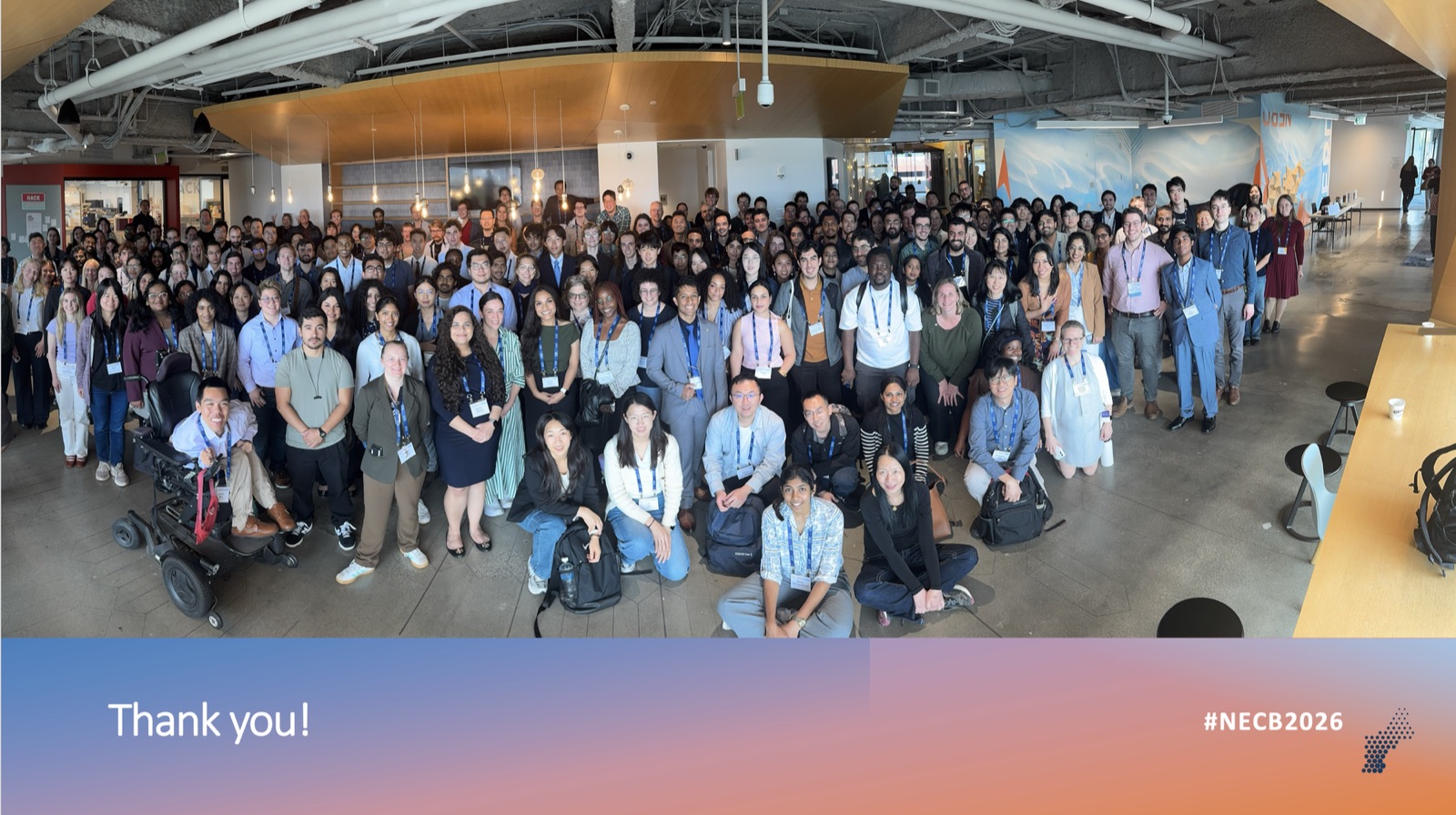
NECB 2026 brings together the New England computational biology community for two days
of keynotes, invited talks, open-problem sessions, selected talks, and posters at
Microsoft Research New England.
We are an in-person, locally rooted symposium with a few simple goals:
make it easy for researchers across New England universities, hospitals, and institutes
to meet each other; create visibility for junior researchers and trainees;
and seed new collaborations at the frontier of computation and the life sciences.
Registration is kept intentionally affordable. The top submitted abstracts will be
selected for talks, and outstanding posters will be recognized with
poster awards.
Poster Sessions
Poster sessions run 2:15–4:15 PM on both days. Each poster goes on the board matching its abstract ID; full abstracts are in the program book (PDF).
Poster format: portrait, up to
36 in wide × 42 in tall (91 × 107 cm).
Mounting putty provided on site — please bring your printed poster with you.
Setup: please hang your poster on the assigned board
the morning of your session day, before the first
talk. Board numbers and full logistics will follow closer to the
meeting.
Day 1 · Thu Oct 1, 2026 · 2:15–4:15 PM
86 posters
- A009
Integrating pharmacogenomics and cheminformatics with diverse disease phenotypes for cell type-guided drug discovery
Arda Halu · Brigham and Women's Hospital, Harvard Medical School
- A012
Uncovering Heteroxylan Biosynthesis in Rice through Network-Based Gene Discovery and Protein Interaction Analysis
Mohsin Ali Nasir · Ohio University
- A015
AI-Guided Therapeutic Strategies to Combat Viral Evolution
Muhammad Asif Ali · University of Illinois, Urbana-Champaign
- A020
Luxemia: Pan-Leukemic Algorithmic Relapse Prediction via Federated Gradient Boosting Ensembles with SHAP-Based Clinical Interpretability
Jacopo Martelli · Broad Institute
- A025
Deciphering Fetal Endothelial Cell Programs to Enhance Vascular Maturation in Human Organoid Models
Paria Pooyan · Royan Institute for stem cell biology and technology
- A027
Modeling the Competition Between Transcription Factors and DNA Repair Enzymes for Recognition of DNA Mismatches
Anthony Lau · UMass Chan Medical School
- A028
From Evidence to Simulation: Multi-Agent AI for Cancer Screening
Maria Sol Rosito · Dana-Farber Cancer Institute
- A029
Decoding the Thermodynamic Competition Between APP-C99 Dimerization and Membrane Partitioning
Sangram Prusty · Boston University
- A030
Collective Dynamics of Confined Water in Amyloid Fibrils
Sonali Priyadarshini Nayak · Boston University
- A032
Single-Cell Transcriptomics Reveals a Transient Lipid-Associated Macrophage Response to Beta-Catenin/CBP Inhibition in Oral Squamous Cell Carcinoma
Sanjana Bhagavatula · Boston University Chobanian & Avedisian School of Medicine
- A036
Systematic Identification and Characterization of Transcriptional Silencers Across Viral Genomes
Mohamed Yousry ElSadec · Bioinformatics Program, Boston University
- A040
A single nucleus multiome QTL atlas of the aging human brain maps regulatory variation underlying Alzheimer's disease risk
Louis Liu · Memorial Sloan Kettering Cancer Center, Weill Cornell Medicine
- A041
Signature Recontextualization: Mapping perturbational signatures across biological context
Andrew Chen · Boston University
- A042
Understand the Effect of Genetic Variants on Alzheimer's Disease
Nguyen Tran · The University of Massachusetts Lowell
- A044
Repeated repurposing of nitrogenase-like proteins revealed by proteome-scale interaction prediction
Subhadeep Chowdhury · Bioinformatics program, Faculty of Computing and Data Sciences, Boston University
- A045
Characterization of novel isoforms in whole blood long-read trio RNA sequencing in rare disease
Jialan Ma · Broad Institute
- A046
Integrative transcriptomic analysis identifies long noncoding RNA dysregulation and circadian disruption in reward and executive circuits of opioid use disorder
Lina Yan · UMass Chan Medical School
- A047
LINGO: A Knowledge Graph-Grounded Foundation Model for Single-Cell Lineage Inference
Kaifu Chen · Boston Children's Hospital
- A048
Single-cell transcriptomic profiling of IL-4/IL-13 receptor expression across pancreatic tumorigenesis
Stergiani Telliou · Massachusetts General Hospital/ Harvard Medical School
- A049
Externally Validating Steered Disease Features in Single-Cell Foundation Models
Mingxin Liu · Department of Biotechnology, Brown University
- A050
Confounder-Aware Feature Correction for Single-Cell Batch Integration
Calvin McCarter · Aureka Biotechnologies
- A054
Integrative Radiogenomic Analysis Identifies Imaging-Linked Molecular Subtypes and Biomarkers in Pancreatic Ductal Adenocarcinoma
Zhi Qu · Department of Radiation Oncology, University of Rochester Medical Center
- A057
Composable foundations for agentic genomics
Nezar Abdennur · UMass Chan Medical School
- A062
The Genomic Interval Query Language (GIQL): A declarative, engine-agnostic grammar for genomic analysis
Conrad Bzura · Department of Genomics and Computational Biology, UMass Chan Medical School
- A067
Divide and Conquer: Scalable Partial Correlation Network Inference for High-Dimensional Omics Data
Luke Berger · Boston University
- A068
Unsupervised extraction of interpretable, functional programs from spatial transcriptomics through a contrastive learning framework
Neal Kewalramani · Boston University
- A069
A Proteogenomic Machine Learning Approach to Evaluate Proteoform-Level Physiological Stability at Genome Scale
Senbao Lu · Worcester Polytechnic Institute
- A070
Replicating Pharmacogenomic Associations in All of Us: An EHR-Based Pipeline for FDA-Labeled Drug-Gene Pairs
Julia James · University of Massachusetts Lowell
- A071
Interpretable and scalable spatial gene set activity analysis with GESSO uncovers functional tissue architecture
Chichun Tan · Department of Biostatistics, Brown University
- A072
Reconstructing Intra-Tumor Fitness Landscapes from scSeq CNA Genotypes via Simulation-Based Bayesian Inference and Deep Learning
Maryam KafiKang · University of Connecticut
- A074
CrossHONA: Cross-species HOmologous and Non-homologous gene-aware framework for transcriptomics integration and Annotation
Ruohan Wang · Brown University
- A078
Sn-seq analysis reveals distinct pathway programs in Gpr149+ vs GPR149- Medium Spiny Neurons in Parkinsons Disease
Saatvik Viniak · University of Illinois Chicago
- A081
Benchmarking LLM-based cell type annotation for standardized reanalysis of public single-cell RNA-seq data
Eva Fast · Pfizer
- A082
TissueCircuit disentangles active signaling circuits from cell-type structure
Taiqi Li · Harvard Medical School
- A083
IGVF Single-cell Perturb-Seq Pipeline, a unified framework for complex data analysis and perturbation inference
Lucas Ferreira da Silva · Massachusetts General Hospital · Harvard Medical School
- A085
Stacked SVD or SVD stacked? A Random Matrix Theory perspective on data integration
Tavor Baharav · Broad Institute
- A089
Tracing oncogene amplification and genome architecture across single-cell tumor phylogenies
Kit Gallagher · Massachusetts General Hospital, Harvard Medical School, Broad Institute
- A090
Identifying Germline Drivers of Neuroblastoma by Their Interaction with Somatic Mutation
Jakob Mikhaylov · University of Massachusetts Lowell
- A096
Single-Cell Mapping of Malignant Signaling Networks Guides Drug Combinations
Bengi Ruken Yavuz · Cancer Innovation Laboratory, National Cancer Institute
- A099
Folding It In: Structure-Aware Deep Splicing Models
Utkarsh Goel · Courant Institute of Mathematical Sciences, New York University
- A101
Transferring Disease Knowledge from Biomedical Literature to Longitudinal Clinical Records for Inborn Error of Immunity Phenotyping
Mansooreh Ahmadian · University of Colorado Anschutz Medical Camp
- A112
From Surface to Core: Mechanistic Interpretation of Rare Disease VUSes through Structure-based Analysis
Tongxin Wang · Harvard Medical School
- A115
Customizing protein evolution with Fitness Landscape Design (FLD)
Vaibhav Mohanty · Harvard University and MIT
- A119
One Age, Many Clocks: System-Specific Metabolomic Aging and Its Links to Diet, Cognition, and Mortality
Anastasia Leshchyk · Tufts Medical Center; Tufts University School of Medicine
- A123
DTWarp: Dynamic Time Warping Alignment for RNA and Protein Identifies Protein-Level Effectors of Epithelial-to-Mesenchymal Transition
Ruohong Wang · Boston University
- A125
Paired single-cell transcriptome and TCR-repertoire analysis reveals convergent CD4⁺ T cells in recurrent mucosal inflammation
Apoorva Sharma · University at Buffalo
- A127
Community Visualization Hub: Integrative Visualization of Multimodal Biomedical Data Across Consortia
Vedat Yilmaz · UMass Chan Medical School
- A128
A novel RNA motif discovery pipeline to elucidate GLDR-2 target recognition
Melissa Badendieck · Worcester Polytechnic Institute
- A134
ProtScape: A molecular structure and energy-aware representation for protein conformation generation
Siddharth Viswanath · Yale University
- A136
Performance of PTM Identification Strategies in Mass Spectrometry Proteomics Search
Alec Candib · Bioinformatics Program, Faculty of Computing and Data Science, Boston University
- A137
Evolutionarily constrained immunotherapy targets encoded by oncogene amplicons in cancer
Curie Cha · Massachusetts General Hospital, Harvard Medical School, Broad Institute
- A141
Influence Causal Ordering: Scalable Causal Structure from Genome-Scale Perturbation Screens
Ritwik Anand · Northeastern University
- A143
Quantitative Modeling of Transcription Factor Binding to UV-Damaged DNA, and Competition with UV-DDB
Yuncheng Duan · UMass Chan Medical School
- A144
eIF5A Depletion Increases Ribosome Occupancy at Cotranslational Ssb Chaperone Binding Sites
Eimaan Bilal · Stony Brook University
- A150
Resolving Mentions to Ontology Gaps in Biomedical Entity Linking
Hyun Seung Lim · Northeastern University
- A151
Generalizable and scalable protein stability prediction with SPURS
Ziang Li · Georgia Institute of Technology
- A157
Leveraging naturally occurring sex chromosome variation in humans to identify loci that shape transcriptomic sex differences
Erik Owen · MIT / Whitehead Institute
- A158
Incorporating differential geometric features into deep learning models for lung cancer screening
Shaun Ng · Boston University Academy
- A159
Visualize Scverse Data Structures and 3D Tissue Maps in Vitessce
Mark Keller · Harvard Medical School
- A160
NLP-Driven Identification of Acculturative Barriers to Depression Treatment for Ethnic Minority and Immigrant Youth
Tanzila Alam · Harvard Medical School
- A161
Investigating the impact of promoter-promoter interactions on gene regulation
Mary Likhite · UMass Chan Medical School
- A164
Integrated analysis of Chromatin Accessibility and Regulon Activity suggests candidate Regulatory Programs in Polarized Porcine Monocyte-derived Macrophages (MDM)
Mehak Kapoor · Iowa State University
- A166
Sparse autoencoders recover molecular mechanisms of disease in protein language models
Karna Mendonca · Northeastern University
- A167
Interactive Guided Annotation for Single-Cell and Spatial Multi-Omics Visualization in Vitessce
Ryan P. Seaman · Harvard Medical School
- A168
HyperFlow: Hypergraph-Based Flow-Matching for Protein Conformation Generation
Janmejay Vyas · Northeastern University
- A169
Evaluating Computational Deconvolution Methods and Optimizing Gene Signature Matrices for Rare Cell Detection in Pediatric Cancer Liquid Biopsies
Kenia Viri · Salve Regina University
- A170
EMMA: A Generative Energy-based Model for Multiscale Architecture of Spatial Transcriptomics
Wonyl Choi · Boston University
- A173
Convergent B-cell receptor sequence features point toward shared antigen targets in colorectal cancer
Ping Lu · Massachusetts General Hospital · Harvard Medical School · Broad Institute
- A175
SIMBA+: Interpreting GWAS through single-cell multiomic graphs identifies disease-relevant genes and cell states
Jayoung Ryu · New York University
- A176
Reconstructing Early Tumor Evolution in BRCA Carriers Using Long Read Single-Cell RNA-sequencing
Grace Li · Krantz Family Center for Cancer Research, Mass General Brigham
- A177
Short tandem repeat polymorphisms mediate transcriptional heterogeneity in Ewing sarcoma
Gregory Brunette · Harvard Medical School
- A178
Agentic In Silico Testing of LLM-Generated Biomedical Hypotheses: A CAR-T Biomarker Case Study
Yunmai Wang · Computational Biology and Biomedical Informatics, Yale University
- A181
Causal Path Inference on a Literature-Derived Knowledge Graph for Variant Effect Interpretation
Jici Jiang · Northeastern University
- A182
In-Silico Characterization of Plumbagin Binding to Multiple Protein Targets Using Molecular Docking
Rachel Mathew · South Windsor High School
- A184
CellVELA: Functional Alignment of Cell Foundation Models for Cancer Vulnerability Discovery
Jiayi Li · Broad Institute
- A191
Robust dynamics of somatic short tandem repeat expansions using donor-specific assembly
Suhas Rao · Harvard Medical School, Department of Biomedical Informatics
- A192
Structural Optimization of Desotamide B for Combating Mycobacterium Tuberculosis
Matthew Lin · Independent
- A193
ACCORDION: aligned condition-specific gene representations for multi-sample single-cell analysis
Renjie Wu · Massachusetts General Hospital
- A201
Somatic copy number changes of the active and inactive X chromosome are new genomic hallmarks of cancer
late-breaking
Matthew Leventhal · Dana-Farber Cancer Institute
- A203
Airqtl dissects cell state-specific causal gene regulatory networks with efficient single-cell eQTL mapping
late-breaking
Matthew Funk · Department of Genomics and Computational Biology, UMass Chan Medical School
- A204
Perturb-LM: Leakage-Aware Language Retrieval of Cell Painting Morphology
late-breaking
Makenna Rodriguez · National Institutes of Health
- A208
Building dynamical models of multi-step state transitions from single cell gene expression trajectories
late-breaking
Yukai You · Northeastern University
- A214
Mathematical Modeling of Macrophage Polarization Dynamics and Molecular Feedback to Predict Immune Modulation Strategies
late-breaking
Veena Naveen · Northeastern University
- A217
Hyaline: Structure and Leakage-Aware Prediction of Kinase Conformational Selectivity
late-breaking
Manju Selvakumaran · Northeastern University
- A220
Structural Modeling Identifies a Putative, MIF-Independent CD74–IFNGR1 Interface in IFN-γ Signaling
late-breaking
Nesma E Abdelaal · Brigham and Women’s Hospital, Harvard Medical School
- A221
Integrative in silico analysis of tumor-associated extracellular vesicles reveal markers related to THY-1 in basal-like breast cancer
late-breaking
Pedro Enrique Soares de Lima · University of Sao Paulo
Day 2 · Fri Oct 2, 2026 · 2:15–4:15 PM
82 posters
- A002
BBB-Nuke: Transport-Aware Prediction of Blood-Brain Barrier Penetration in Small Molecules
Noah Abasciano · Attention Labs
- A003
Elucidating enzyme–substrate specificity through co-folding foundation model
Xiwei Cheng · Northeastern University
- A007
An Open, Wet-Lab-Free In-Silico Pipeline for Allele-Specific Detection of Autosomal-Dominant Early-Onset Alzheimer's Disease Mutations
Sunanditaa Karthikeyan · Northeastern University
- A008
A fast and memory-efficient framework for similarity networks in biology
Sean R. Johnson · New England Biolabs
- A010
A Single-Cell Analysis of State-Restricted and Uniform Collateral-Lethality Dependency Signatures in Pancreatic Ductal Adenocarcinoma
Om Rajesh · The Woodlands High School
- A011
Elucidating the role of TaVER2 and Rice orthologs in Xylan biosynthesis
Samia Nawaz · Ohio University
- A013
Can AI Scientists Discover Better Drugs? Automating Objective Design, Property Prediction, and Molecular Optimization
Yikun Zhang · Northeastern University
- A014
Fungal Gene Essentiality Prediction with Genomic Language Models
Chen Liao · Dartmouth College
- A018
An ecology-grounded comparison of VAE and diffusion models for microbiome abundances
Jeremie Theddy Darmawan · Singapore-MIT Alliance for Research and Technology (SMART)
- A019
Characterizing Ancestry-Related Heterogeneity Between Additive and Recessive GWAS Models for Type 2 Diabetes
Christelle Moise · Broad Institute, Broad Summer Scholars Program (BSSP)
- A024
Genetic Regulation of Circular RNAs Reveals a Distinct Molecular Layer Underlying Psychiatric Risk
Aarti Jajoo · McLean Hospital
- A026
Embedding kernels for sequence-function relationships
Waverly Carabba · Tufts University
- A037
Aging-associated Mechanisms of Aggressiveness in HPV(-) Head and Neck Cancer
Lina Kroehling · Boston University
- A043
Single-base mapping of m6A in lncRNAs reveals a distinct landscape linked to transposable elements and RNA processing
Euijin Kwon · UMass Chan Medical School
- A052
Structure and Sequence Guided Drug Repurposing Framework for Antimalarial Target Discovery
Fatemeh Ensafitakaldani · University of Massachusetts, Boston
- A053
CellFun: Decoding Cellular Functions from Single-Cell and Spatial Transcriptomics with Agentic AI
Kulandaisamy Arulsamy · Department of Cardiology, Boston Children's Hospital
- A055
HyperCom: a hypergraph based method to infer cell-resolved cell-cell communication
Justin Moy · Boston University
- A059
Agent-driven annotation and interpretation of morphological signatures in optical pooled screening
Ana Karla Cepeda Diaz · Whitehead Institute for Biomedical Research
- A060
Sequence-Conditioned Generation of Genome-Targeting Integrases with a Genomic Foundation Model
Tanggis Bohnuud · Basecamp Research
- A061
An XOR-based framework for detecting mutually exclusive gene modules in single-cell data
Irzam Sarfraz · Boston University Chobanian & Avedisian School of Medicine (CAMED)
- A063
BaseEvolve: AI-guided directed evolution of large serine recombinases for therapeutic gene insertion
Aaron Kollasch · Basecamp Research
- A065
Discovering Biological Signals in the Noise
Sophia K. Cheng · University of Michigan
- A066
Comprehensive cancer transcriptome analysis reveals lncRNA-derived gene fusions as a widespread class of recurrent alterations with oncogenic potential
Chan Zhou · UMass Chan Medical School
- A073
PerturbRx: Treatment-Conditioned Latent Transitions for Patient Drug Response Prediction
Yoshitaka Inoue · University of Minnesota
- A075
scBrieflow: a single-cell analysis platform for understanding morphological readout of optical pooled screens
Ege Topkoc · Whitehead Institute
- A077
Statistical detection of drivers of hematopoietic differentiation from lentiviral integration site datasets
Giacomo Ceoldo · Boston Children's Hospital - Harvard Medical School
- A084
SigRepo: A Platform For Storing, Sharing, and Comparing Signatures
Cameron Vicnaire · Monti Lab, Boston University
- A086
MUTARA: MUTagenesis Analysis of Relative binding Affinity
Shogan Sugumar Swamy · Boston Children's Hospital
- A091
Clinico-genomic features predict distinct metastatic phenotypes in cutaneous melanoma
Tyler Aprati · Dana-Farber Cancer Institute
- A092
Motif reuse across zinc finger proteins: Insights into function and evolution
Lyah Esplana · Department of Chemistry and Biochemistry, Worcester Polytechnic Institute
- A094
Bridging Genome-Scale Metabolism and Adaptive Ecology: A Hybrid Consumer-Resource Framework for Dynamic Microbial Growth
Edwin Moses Appiah · University of Connecticut Health Center
- A095
MESH-HR: Multimodal Histopathology and Somatic Genomics for Continuous Breast Cancer Receptor Phenotyping
Shaye Carver · Harvard Medical School
- A098
RegScan: A Statistical Framework for Identifying Functional Transcription Factor Binding Sites from Per-Nucleotide Importance Scores
Zain M. Patel · Mass General Hospital, Harvard Medical School, Broad Institute
- A102
Learning Sparse Gaussian Graphical Models from Correlated Data
Zeyuan Song · Tufts Medical Center · Tufts University
- A103
Developmentally Informed AlphaGenome Modeling to Prioritize Noncoding Variants in Genetically Unresolved Congenital Heart Disease
Kristine Yang · Harvard Medical School · Boston Children's Hospital
- A106
Enhancing causal network-based perturbation inference through literature-derived knowledge
Zheng Liu · Northeastern University
- A107
REPEL - Random Embedding Perturbation for Enhanced Learning of Protein Function
Di Zhou · Tufts University
- A108
Fine-tuning Boltz-1 for protein-protein interaction prediction with positive and negative data
Ruqi Liao · Broad Institute · MIT
- A109
Investigating the Transcriptional Program of ACKR1+ Venous Endothelial Cells in Pulmonary Fibrosis Using Single-Cell RNA-sequencing
Uyen Chu · Boston University Chobanian and Avedisian School of Medicine
- A113
A Novel ILP Framework to Identify Compensatory Pathways in Genetic Interaction Networks with GIDEON
Jocelyn Garcia · Tufts University
- A114
TANGO: High-Throughput, Highly Sensitive Measurements of dCas9 Binding to On- and Off-Target Sequences
Michael Tian · University of Massachusetts Medical School
- A116
Discovering disease trajectories using genetic similarity
Sujiyanto · University of Massachusetts Lowell
- A120
Mining protein–RNA complexes for recurring RNA-binding motifs
Sharra MN Lewis · Worcester Polytechnic Institute
- A121
An Agentic Workflow for Adaptive and Auditable Single-Cell RNA-seq Analysis
Luc Francis · Independent Researcher
- A122
Use of Computed Electrostatic and Geometric Information to Investigate Protein Functions and Functional Sites
Tina Harati & Mary Jo Ondrechen · Northeastern University and The University of Illinois Chicago
- A124
Genome-Scale Sub-Megabase Chromatin Tracing with DNA-MERFISH
Peter Ren · Xiaowei Zhuang Lab, Harvard University
- A129
Applications of AI to biomolecules for both answers and insight into enzyme function
Mary Jo Ondrechen · Northeastern University
- A130
A necrosis-associated repeat-element program in metastatic colorectal cancer, and an open problem in separating DNA from RNA
Chenyue Lu · Harvard-MIT Health Sciences and Technology · Dana-Farber Cancer Institute
- A131
Understanding and Correcting Representation-Specific Failure Modes in SE(3) Flow-Matching Protein Backbone Generation
Michael Widener · Northeastern University / Boston College
- A133
Identifying pathogenic tandem repeat expansions at novel loci in short-read and long-read rare disease datasets
Ben Weisburd · Broad Institute
- A135
Beyond Sex Chromosomes: Sex Differences in Transcriptional Signatures of Aged Brain and Alzheimer’s Disease
Danielle Firer · MIT
- A139
Mapping Cis-Regulatory Programs of Pancreatic β Cells in Health and Diabetes
Maxwell Cmpbell · UMass Chan
- A140
POLARIS: concordance-aware joint analysis of cells and features in single-cell multiomic data
Ziqi Fu · Harvard University, Department of Biostatistics
- A142
Consistent Reeb Graph Estimation for Unsupervised Cell-State Topology Discovery
Andrew Steindl · Yale
- A146
Comparative Analysis of ZRS–SHH Genomic Architecture Across Vertebrates
Ziyan Rao · Department of Genomics and Computational Biology, UMass Chan Medical School
- A147
Interactional experimental design for the efficient demonstration of the Plasmodium inhibitory property of an endosymbiont Eα alone or in association in Anopheles mosquitoes within a context of endosymbiotic diversity for the success of biological control
Richard Bationo · Institute of Health Science Research
- A149
SwissIsoform: A Biological and Functional Annotation Database for Translation Start Site Protein Isoforms
Anson Ting · Whitehead Institute, UCLA
- A153
Tryptophan Transporters Modulated by Diet Predict Cognitive and Physical Phenotypes: Implications for Precision Nutrition
Hannah Lords · Bioinformatics Program, Boston University
- A154
A Bayesian approach to dose-response modeling in sparse data regimes
Sameer Rawat · Northeastern University
- A155
Multimodal data-driven approaches for discovery and validation of pneumonia sub-phenotypes
Amulya Shastry · Boston University
- A162
Evolutionary Remodeling of the Human Immune Regulatory Genome
Nicole Shedd · University of Massachusetts Chan Medical School
- A165
MiLaSol: Modeling Protein Solubility by Mixing Up Multiple Protein Language Models
Weiwei Lou · Tufts University
- A171
Bridging Time-to-Event and Generative Deep Learning for Longitudinal Cardiovascular Digital Twins
Siying (Avon) Yang · Department of Epidemiology & Biostatistics , Harvard T.H. Chan School of Public Health
- A174
Do Perturbation Models Need to See the Perturbation?
Danqi Liao · WindMirror
- A179
Calibrated Computational and Functional Evidence for At-Scale Clinical Classification of In-Frame Indels
Haneen Abderrazzaq · Northeastern University
- A183
Differentiable Learning of Nuclear Magnetic Responses with NequIP-NMR
Constance Kraay · Harvard University
- A186
Sparse Autoencoders Recover Reproducible Structural Signal in Protein Language Model Latent Space Representations
Bridget Liu & Andrew Meng · Columbia University
- A187
Augmenting protein stability predictions from generative models with non-equilibrium thermodynamics and physics-based potentials
Kevin Borisiak · Yale University, Department of Physics
- A188
Expression of Cardiac Vagal Sensory Neuron Markers in Human Dilated Cardiomyopathy: A Reanalysis of Public scRNA-seq/snRNA-seq Data
Tetsuo Momiy Nakama · Universidad de Ingeniería y Tecnología
- A189
Beyond Proximity: Does AlphaGenome Add Signal Over Splice-Site Annotation in ALS?
Arghamitra Talukder · Columbia Univeristy
- A190
An ILP Framework for Repertoire-Scale Antibody Lineage Tracking
Faith Abiria Ocitti · Tufts University
- A197
Timing the onset of homologous recombination deficiency before breast cancer diagnosis
Michail Andreopoulos · Department of Biomedical Informatics, Harvard Medical School
- A198
OMNIA: Structural Graph Autoencoder Mapping of Microplastic‑Induced Respiratory Gene Regulation
late-breaking
Sahen Tapar · Lone Star College
- A199
Leveraging Mutational Coldspots to Build an Atlas of Variant Effects
late-breaking
Mariam Benazouz · University of Washington
- A200
A top-down/bottom-up pipeline for the automatic construction of mechanistic mathematical models: reconstructing the regulatory network of tamoxifen resistance in breast cancer
late-breaking
Vikas Pandey · The University of Osaka
- A202
LOCALE: Local-Alignment Embeddings for Noise-Robust DNA Search at SRA Scale
late-breaking
Prashant Pandey · Northeastern University
- A205
SIGMA: interface-aware spectral graph learning for metabolic transitions across pathological tissue boundaries
late-breaking
Bingxue Du · The University of Hong Kong
- A206
AI/ML-enabled screening of FDA-approved drugs against neglected tropic disease targets
late-breaking
Daniel Korkin · Student at Massachusetts Academy of Math and Science
- A207
Ensemble convergence identifies recurrent structural solutions for pH-responsive CXCL8 antibody design
late-breaking
Hung-Pin Peng · Clinical Data Center, Office of Data Science, Taipei Medical University, Taipei, Taiwan
- A209
A Computational Framework for Recovering Molecular Relationships from Biological Pathway Diagrams
late-breaking
Xiwen Zhao · Northeastern University
- A213
Bayesian Negative Binomial Softmax Regression for Compositional Sequencing Count Data
late-breaking
Seong-Hwan Jun · University of Rochester
- A219
Rethinking Large-scale phylogenomics with EukPhylo v.1.0
late-breaking
Godwin Ani · UMass Amherst and Smith College








 View the gallery